Garage Fridge in Winter: 5 Fixes That Actually Work

Most standard refrigerators are designed to operate between 60°F and 110°F — so when your unheated garage drops below freezing, your refrigerator in cold garage situation becomes a real malfunction risk, not just an inconvenience.
When ambient temperatures fall too low, the thermostat stops calling for cooling cycles, the compressor shuts down, and food in both the fridge and freezer compartments reaches unsafe temperatures.
This guide covers the exact root causes behind cold-weather fridge failure and walks you through 5 proven fixes — from simple DIY adjustments to purpose-built products — so you can keep your garage fridge running reliably all winter without replacing it.
Why Your Garage Fridge Stops Working in Cold
Most cold garage appliance problems trace back to one component: the thermostat. Standard refrigerators are not built for unheated garage conditions, and understanding why helps you choose the right fix fast.
How Refrigerator Thermostats Fail Below Freezing
A standard fridge thermostat works by sensing the ambient air temperature around the unit and signaling the compressor to cycle on or off. The problem is that most thermostats are calibrated for indoor living spaces — typically a 50°F to 110°F range.
Here’s the problem. When garage temperatures drop below that threshold, the thermostat reads the surrounding air as already cold enough. It stops triggering compressor cycling entirely. No compressor cycling means no active cooling inside the cabinet — even though the freezer compartment is sitting in frigid air and freezing everything solid. Your fridge is off, but your food is still freezing.
This is why homeowners search “why does fridge freeze in cold garage” expecting a cooling problem, when the real issue is a compressor that never turns on.
The Cold Threshold Every Homeowner Should Know
The minimum safe operating temperature for most standard refrigerators is 50°F. Below that point, thermostat calibration breaks down and the unit behaves erratically.
Whirlpool, Frigidaire, and GE all publish ambient temperature ranges in their product documentation. Frigidaire specifies 60°F–110°F for most models. Whirlpool lists 60°F as the lower limit for standard units. Garage-ready refrigerator models — a separate product category — are engineered with a second thermostat or a built-in heater kit to compensate for temperatures as low as 0°F.
Check your model’s spec sheet before attempting any thermostat adjustment or appliance winterization step.
Quick Fixes Before Buying Anything
Before spending money on a heater kit or a garage-ready replacement, two no-cost adjustments can stabilize a struggling fridge immediately. Neither is a permanent refrigerator winterization method, but both buy you time and protect your food while you plan a real fix.
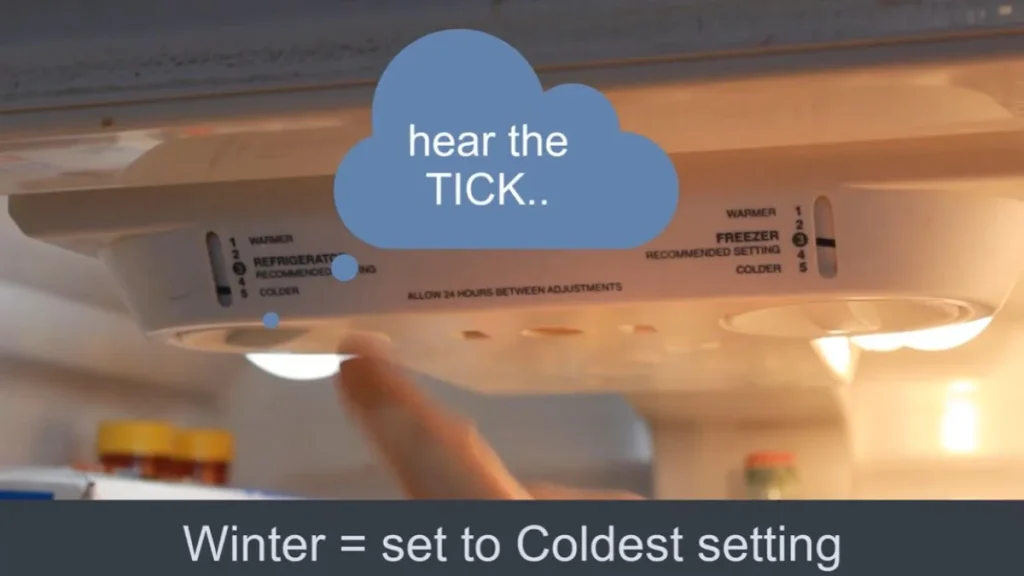
Thermostat Dial Adjustment for Cold Garages
Turning the thermostat dial to a higher (warmer) setting tricks the thermostat into sensing a greater temperature difference between the cabinet interior and the target temp. The result is more frequent compressor cycling, which keeps the unit actively running even when the garage air is cold.
Set the dial one or two notches warmer than your current setting, then wait 4–6 hours. Place a standalone refrigerator thermometer — the Taylor Precision Products model is widely available and accurate to ±1°F — inside the fresh food compartment to confirm temps stay between 35°F and 38°F. Without a thermometer, you’re guessing.
Note that this is a temporary band-aid for thermostat calibration issues, not a structural fix. It will not work once garage temperatures fall below 35°F–40°F consistently.
Strategic Shelving and Food Placement
Cold air sinks, so the bottom shelves of a garage fridge in winter are most vulnerable to freezing. Move temperature-sensitive items — dairy, produce, beverages — to middle shelves, away from the walls and floor zone.
Keep the freezer compartment at roughly 75–80% capacity. A partially full freezer maintains its temperature more efficiently than an empty one, reducing the thermal load on the compressor during irregular cycling. Remove items entirely if freezer compartment frost buildup becomes visible — that signals the unit is struggling to regulate itself.
Garage Refrigerator Heater Kits: Installation & Compatibility
A garage refrigerator heater kit is the most reliable permanent solution for a standard fridge in an unheated garage. It costs between $20 and $60 and directly solves the root cause — thermostat failure in cold air — without replacing the appliance.

How Heating Strips Warm the Thermostat Sensor
The kit wraps a small resistive heating coil around the thermostat’s sensing bulb. That coil generates just enough warmth to convince the thermostat that the ambient air is warmer than it actually is, which keeps triggering compressor cycling normally. The fridge runs as intended, even when garage temperatures drop to 0°F.
In practice, heater kits restore normal operation in roughly 90% of cold garage appliance problems caused by thermostat shutdown.
Step-by-Step Installation Walkthrough
Heater kit installation takes 20–30 minutes and requires only a screwdriver and basic electrical tape. Most kits include a heating element, a wiring harness, and clear instructions.
Follow these steps:
- Unplug the refrigerator completely before starting.
- Remove the interior back panel or temperature control housing to access the thermostat bulb — location varies by model.
- Wrap the heating element snugly around the thermostat sensing bulb.
- Route the wiring harness to a nearby power source inside the unit, following kit instructions.
- Reassemble the panel, plug in the fridge, and monitor temps for 24 hours.
Top-freezer, side-by-side, and French door models are all compatible with standard heater kits.
Brand-Specific Kit Compatibility
| Refrigerator Brand | Recommended Kit Type | Notes |
|---|---|---|
| Whirlpool | Universal or model-specific | Most models use accessible bulb placement |
| GE | Universal kit | Confirm thermostat location before ordering |
| Frigidaire | Model-specific preferred | Some units require brand-matched kits |
Universal kits run $20–$35. Model-specific kits cost $40–$60 but offer cleaner installation and better long-term reliability.
Garage Temperature Management & Alternatives
Sometimes the right refrigerator winterization method isn’t about the fridge at all — it’s about the garage. Keeping ambient temps above 50°F solves cold garage appliance problems at the source, and in some setups, it costs less than ongoing appliance repairs.
Ideal Ambient Temperature Range for Appliances
The target range for reliable fridge operation is 50°F to 85°F. Staying above 50°F prevents thermostat dropout entirely, eliminating the need for any other intervention.
Three garage temperature regulation options worth considering:
- Insulation improvements — Adding rigid foam board insulation to garage walls and the ceiling can raise ambient temps by 10°F–15°F in mild climates at a one-time cost of $150–$400 for a standard 2-car garage.
- Space heaters — A 1,500-watt electric space heater like the Dr. Heater DR-988 can maintain 50°F+ in an insulated garage when exterior temps stay above 20°F. Running cost averages $30–$50/month depending on local electricity rates.
- Door weatherization — Sealing gaps around garage doors with adhesive weatherstrip tape costs under $30 and meaningfully reduces cold air infiltration.
If your garage is already partially insulated and you live in a climate where temps rarely drop below 25°F, a space heater alone may cost less annually than replacing a fridge.
Garage-Ready Refrigerator Models
Garage-ready refrigerator models are engineered specifically for unheated garage fridge situations. The Whirlpool Chillerator operates reliably from 35°F to 110°F using a dual-thermostat system. LG and Gladiator also offer garage-rated models in the 18–20 cubic foot range.
The cost premium is real — garage-ready units typically run $200–$500 more than comparable standard models. That premium makes sense only if your current appliance is already 10+ years old or showing additional mechanical problems beyond cold-weather shutdown.
Is It Safe to Keep a Fridge in an Unheated Garage?
Keeping a standard refrigerator in an unheated garage carries real risks beyond inconvenience. Food safety, mechanical damage, and warranty coverage are all affected when ambient temperatures fall outside the designed operating range.
Food Safety When the Thermostat Fails
When compressor cycling stops due to cold ambient air, the fridge compartment temperature rises toward whatever the garage temperature is. If your garage hits 50°F, your fridge interior may reach 50°F too — well above the USDA’s recommended maximum of 40°F for safe food storage. Meat, dairy, and prepared foods become unsafe within 2 hours above 40°F.
The freezer compartment presents the opposite problem. Without active cycling, frozen food may partially thaw and refreeze repeatedly, degrading texture and creating bacterial growth risk in proteins.
Mechanical Damage From Extreme Cold
Compressor oil thickens significantly below 35°F. When the compressor finally does cycle on after sitting in near-freezing conditions, it works against increased resistance — accelerating wear on seals and internal components. Repeated freeze-thaw cycles on refrigerant lines can also cause micro-fractures over time, leading to refrigerant leaks that require professional repair averaging $200–$400.
Warranty and Long-Term Durability
Most manufacturer warranties — including those from Whirlpool, GE, and Frigidaire — explicitly exclude damage caused by operating the appliance outside its specified ambient temperature range. That means a compressor failure traced to cold garage conditions is unlikely to be covered, even on a unit less than a year old.
For long-term durability, climate-controlled storage or a purpose-built garage-ready model is the only guaranteed protection against seasonal appliance maintenance costs compounding year over year.
This is closely related — see the specific fix for a fridge that’s freezing food in cold weather.
Choose Your Fix Based on Budget and Setup
A $20–$60 garage refrigerator heater kit solves the root cause for most homeowners without replacing the appliance or heating the entire garage. Check your fridge’s manufacturer spec sheet today to confirm its minimum operating temperature, then order a compatible heater kit — universal models from Amazon fit Whirlpool, GE, and Frigidaire units and install in under 30 minutes. If your unit is over 10 years old or the garage regularly drops below 0°F, budget instead for a garage-ready model like the Whirlpool Chillerator.