How to Stop Your Garage Fridge From Freezing Food

When outdoor temperatures drop below 35°F, most garage refrigerators start behaving like freezers — and knowing how to keep garage refrigerator from freezing comes down to understanding exactly why that happens.
The lettuce is limp, the beer is slushy, and everything on the bottom shelf is solid — a frustratingly common problem once fall hits and your garage drops into the 30s.
This guide walks you through the exact cause of garage fridge freezing, how to diagnose your specific situation, and which fixes — ranging from free thermostat adjustments to a $30 garage kit — match your budget and skill level.
Why Cold Garages Trigger Freezing (Physics + Mechanics)
A standard refrigerator thermostat is calibrated for a 70°F indoor environment — put it in an unheated garage during winter, and the entire temperature regulation system works against you.
The Thermostat Sensor Problem
The thermostat sensor inside your fridge measures the air temperature inside the cabinet, then signals the compressor to run until that interior temperature hits your set point. Here’s the problem. When garage ambient temperature drops below 50°F, the air surrounding the fridge is already cold enough that the sensor reads “cool enough” almost immediately — but the compressor keeps running anyway because the freezer compartment drives the cooling cycle, not the fridge section.
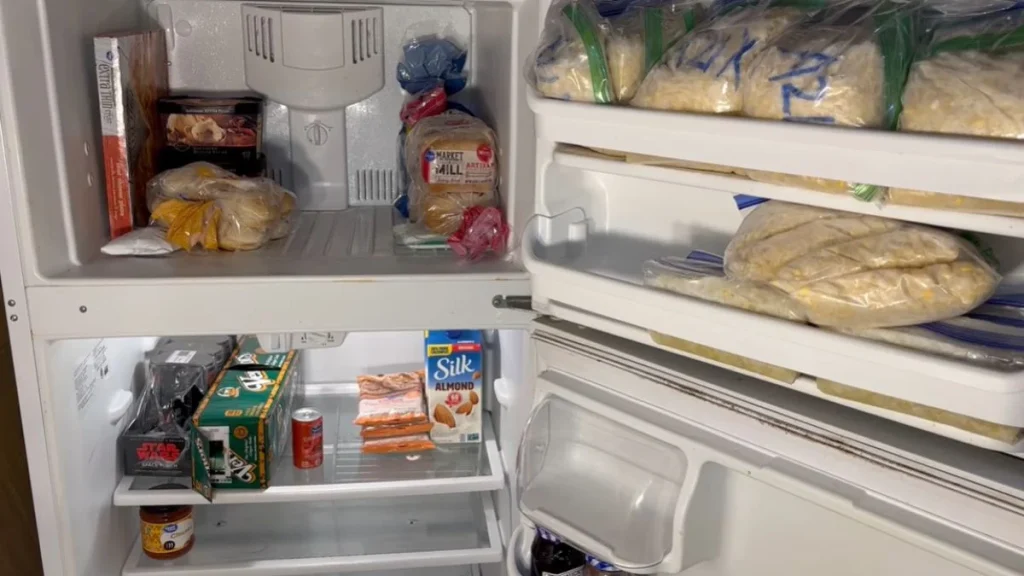
The fridge section shares cooling coils with the freezer. Excess cold from an over-running compressor spills directly into the refrigerator compartment, dropping it well below 35°F and freezing everything inside.
Why Standard Fridges Aren’t Built for Cold Garages
Refrigerator manufacturers design thermostats assuming the appliance sits in a climate-controlled kitchen between 60°F and 90°F. Below 50°F ambient — the threshold where garage refrigerator freezing food in winter becomes a real problem — the compressor cycling logic breaks down. Below 35°F ambient, some units stop running the compressor entirely, which causes the opposite problem: food spoilage in the fridge and freezer melt.
This is not a thermostat sensor malfunction in the traditional sense. The sensor is working correctly. The design simply never accounted for cold weather appliance operation in unheated garage conditions.
Quick Fixes You Can Try Today
Before spending money on parts or calling a technician, 3 free adjustments can resolve freezing in many cases — and take less than 10 minutes each.

Adjust the Thermostat to Its Warmest Setting
Most refrigerator dials run from 1 (warmest) to 7 or 8 (coldest) — counterintuitively, a higher number means more cooling, not less. Set yours to the warmest position, which is typically 1. In unheated garage conditions, this single garage-ready refrigerator thermostat adjustment is enough to stop over-cycling during mild cold snaps when ambient temperature stays above 40°F.
Check the Thermostat Sensor Position
The thermostat sensor is a small metal or plastic probe, usually clipped to the interior back wall or an evaporator coil. If it’s touching ice buildup or pressed directly against the rear wall, it reads temperatures lower than the actual cabinet air — which drives compressor cycling longer than needed. Gently reposition it so it hangs freely in open air inside the fridge compartment.
Pull the Fridge Away From the Wall
Compressors generate heat as a byproduct. That heat needs somewhere to go. When a fridge sits flush against a wall in a cold garage, heat dissipation drops and temperature regulation becomes erratic. Move the unit 3 to 4 inches from the back wall and check whether the compressor runs continuously — constant running is a clear sign of over-cycling.
Verify Actual Temperature With a Thermometer
Never trust the dial alone. Place a standalone thermometer — the Taylor 3516 is a reliable, inexpensive option — on the middle shelf for 30 minutes. A reading below 35°F confirms freezing conditions and tells you the free fixes haven’t fully solved the problem yet.
For the broader set of solutions to cold-garage fridge problems, see this guide.
Heater Kits vs. Garage Heaters: Product Solutions Compared
When free adjustments aren’t enough, 2 product categories solve garage refrigerator freezing in winter — one targets the fridge directly, the other targets the garage environment.
Garage Fridge Heater Kits
A garage fridge heater kit wraps an insulated heating cord around the thermostat sensor. The cord applies just enough warmth to make the sensor read a temperature closer to 70°F — even when garage ambient temperature is well below that. The compressor then cycles normally, and temperature control for your secondary fridge stabilizes.
The most widely used option is the Fridge Defend kit, available on Amazon for $30–$50. Garage fridge heater kit installation requires no electrical work beyond plugging the cord into a standard outlet. Most homeowners complete it in under 20 minutes with no tools.
Garage-Ready Refrigerators
The Chillerator, made by Gladiator (a Whirlpool brand), is purpose-built for cold weather appliance operation. It includes a built-in heater around the thermostat sensor from the factory, rated to function correctly down to 0°F ambient. The cost runs $800–$1,200 — worth the investment if you’re replacing an aging unit, but hard to justify solely to fix a freezing problem on a working fridge.
Whole-Garage Heating Solutions
A portable space heater or ductless mini-split keeps the entire garage above 50°F, which eliminates the ambient temperature problem at the source. This approach makes sense only if you use the garage year-round as a workshop or living space — otherwise, the energy cost outweighs the benefit of protecting one appliance.
| Solution | Cost | DIY-Friendly | Best For |
|---|---|---|---|
| Fridge Defend heater kit | $30–$50 | Yes | Quick, targeted fix |
| Chillerator fridge | $800–$1,200 | N/A | Full replacement scenario |
| Portable space heater | $40–$150 | Yes | Multi-use garage |
| Ductless mini-split | $1,500–$3,000 installed | No | Year-round garage use |
Garage-Ready Refrigerators: When to Upgrade
A garage-ready refrigerator is not just a marketing label — it describes a unit with a thermostat and compressor system engineered to cycle correctly when ambient temperature drops below 50°F.
What “Garage-Ready” Actually Means
Standard fridges rely on a single thermostat that reads interior cabinet air. Garage-ready models add a second sensor or a built-in heating element near the thermostat to prevent false cold readings. This means the compressor cycling logic stays accurate even when unheated garage conditions push ambient temperatures into the 20s and 30s. The result is consistent temperature regulation without any add-on kit.
Top Brands With Verified Cold Weather Operation
3 manufacturers build fridges with genuine garage-mode capability:
- GE — Several GE Profile and GE Garage-Ready models are rated for operation down to 0°F ambient
- Whirlpool — The Gladiator Chillerator line (a Whirlpool sub-brand) is purpose-built for unheated garage conditions
- LG — Select LG French door models include a “Garage Mode” setting activated through the control panel, rated to 0°F
Always confirm “garage ready” in the spec sheet, not just the product title — some listings use the phrase loosely.
Cost Comparison and Payback Period
| Solution | Upfront Cost | Breaks Even |
|---|---|---|
| Heater kit (Fridge Defend) | $30–$50 | 1–2 seasons |
| Garage heater (portable) | $40–$150 | 2–3 seasons |
| Garage-ready refrigerator | $600–$1,500 | Justified only at replacement |
A heater kit is the clear winner for a working fridge under 10 years old. Upgrading to a garage-ready unit makes financial sense only when your current appliance is already unreliable, inefficient, or nearing end of life.
Year-Round Garage Fridge Maintenance Checklist
A garage refrigerator needs seasonal attention that a kitchen fridge never does — ambient temperature swings of 60°F or more between summer and winter change how the appliance behaves every few months.
September–October: Pre-Winter Prep
Before cold weather appliance operation becomes a real stress test, do 2 things. First, place a thermometer inside the fridge for 24 hours and confirm the interior holds between 35°F and 38°F. Second, clean the condenser coils — typically located behind a kick plate at the bottom front or along the back of the unit. Dust-clogged coils force the compressor to work harder, which amplifies over-cycling problems once ambient temperature drops.
November–March: Active Cold Season Monitoring
Check the internal temperature monthly using a standalone thermometer like the AcuRite 00986. If readings drop below 35°F, dial the thermostat toward its warmest setting or verify your heater kit is plugged in and functioning. Compressor cycling — listening for whether it runs constantly or in normal on/off intervals — is a fast secondary check that takes 5 minutes.
April–May: Post-Winter Inspection
Inspect the door gasket (the rubber seal around the fridge door) for cracks, gaps, or sections that no longer grip the cabinet frame. A failing gasket lets warm spring air seep in, which increases compressor cycling and energy costs heading into summer.
Track Your Settings Year Over Year
Keep a notebook — or a note in your phone — logging thermostat dial positions and monthly temperature readings by season. Patterns emerge quickly: most homeowners find they need the dial at position 2 from November through February, then back to 4 by April. That record eliminates guesswork every fall.
Your Next Step
Garage fridge freezing is a thermostat design problem, not an appliance failure — and it has a proven, inexpensive fix. Start today by placing a thermometer on the middle shelf for 30 minutes to confirm your actual interior temperature, then adjust the dial to its warmest setting. If readings stay below 35°F after 24 hours, order a Fridge Defend heater kit and install it before the next cold snap hits.